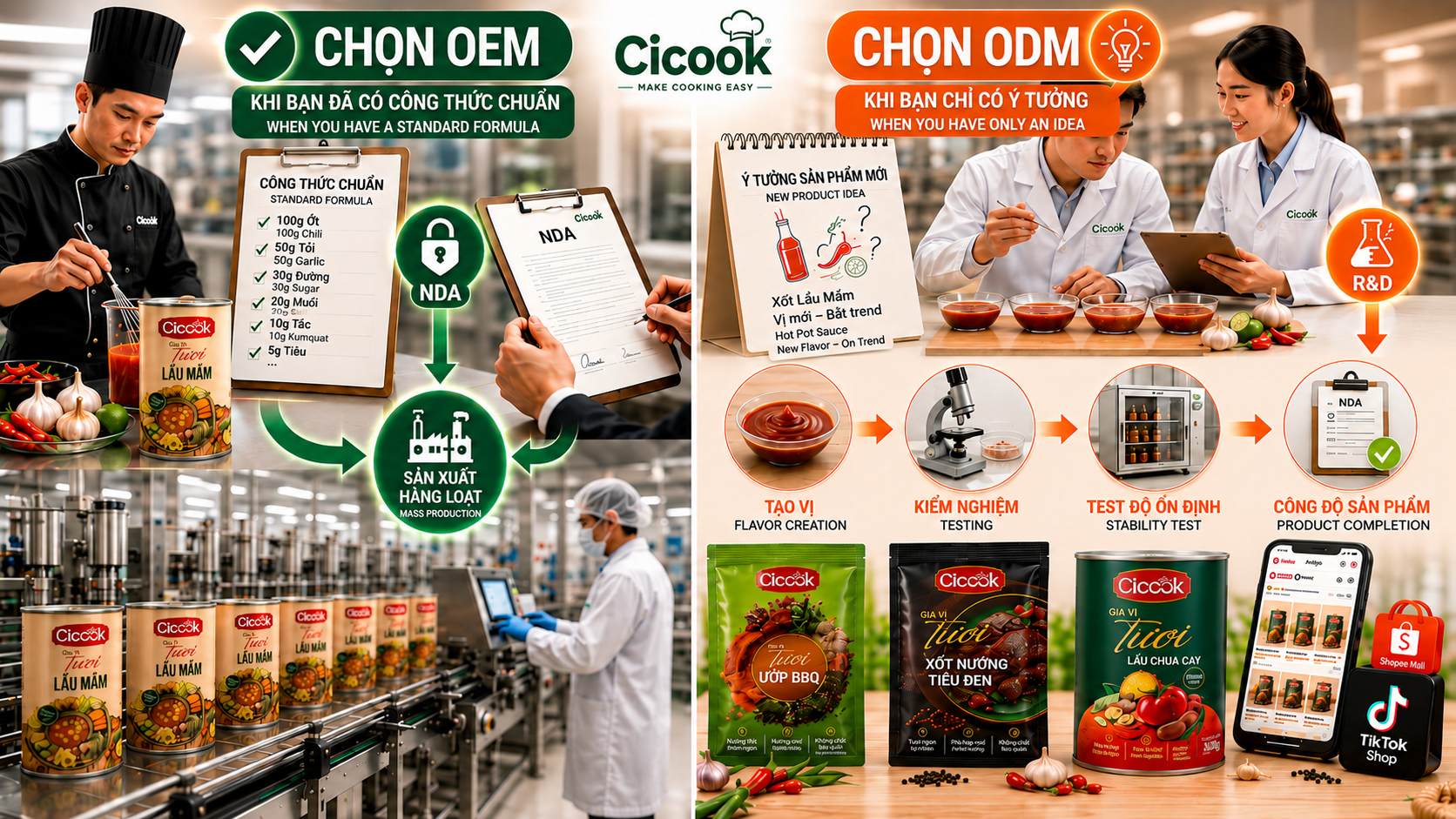
OEM and ODM both help businesses build private-label seasoning brands but differ in product development. OEM is ideal for existing recipes, while ODM suits companies needing new product development. CiCook provides tailored solutions based on business goals, budget, and market strategy.
F&B businesses should choose OEM (Original Equipment Manufacturing) if they already own a standardized recipe and simply require Cicook's certified manufacturing facilities to produce at scale while optimizing production costs.
On the other hand, ODM (Original Design Manufacturing) is the ideal solution for businesses that have only a product concept, desired flavor profile, or wish to improve an existing recipe. Cicook's R&D team develops, tests, and manufactures an exclusive formulation from concept to commercial production.
Each manufacturing model offers unique advantages in terms of investment, speed to market, and product development strategy. To help FMCG brands, startups, and restaurant chains make the right decision, Cicook provides the following comparison.
1. OEM vs. ODM Comparison
| Comparison Criteria | OEM Manufacturing | ODM Manufacturing |
|---|---|---|
| Formula Ownership | The client owns the formula before production begins. | Cicook's R&D team develops the formulation and transfers exclusive ownership to the client upon project completion. |
| R&D Support | Technical adjustments are made only to adapt the client's existing formula for industrial production. | Complete product development including formulation, sampling, stability evaluation, and optimization. |
| Initial Investment | Lower development costs, but typically requires a more structured production plan and MOQ. | Eliminates the need to build an in-house R&D department. Prototype samples are developed within 48 hours. |
| Time to Market | Faster because the recipe is already finalized. | Usually requires one to two weeks for formulation refinement and shelf-life validation before mass production. |
| Best Suited For | Established restaurant chains and food manufacturers with standardized recipes. | Startups, emerging brands, and restaurant chains introducing new menu items or packaged products. |
2. Which Manufacturing Model Should You Choose?
Choosing the right manufacturing model helps reduce unnecessary investment while accelerating product commercialization.
Choose OEM If...
OEM is recommended when your business already possesses a proven, standardized recipe.
Typical examples include:
-
Restaurant chains operating multiple locations
-
Businesses with internal R&D laboratories
-
Companies whose chefs have already standardized ingredient ratios by weight or volume
Simply provide your existing formulation to Cicook. After executing a Non-Disclosure Agreement (NDA), we industrialize your recipe using our automated manufacturing systems while maintaining complete confidentiality and consistent product quality.
Choose ODM If...
ODM is the ideal choice when you have a product idea but require technical expertise to transform it into a commercially viable product.
Examples include:
-
Launching a packaged hot pot soup base
-
Developing a signature green chili dipping sauce
-
Creating innovative seasoning products for Shopee, TikTok Shop, supermarkets, or export markets
Cicook manages the entire development process, including:
-
Flavor research and formulation
-
Ingredient optimization
-
Shelf-life testing
-
Microbiological analysis
-
Packaging consultation
-
Regulatory documentation
-
Commercial manufacturing
This turnkey solution allows you to focus on brand development and sales while our specialists handle the technical aspects.
3. Frequently Asked Questions (FAQ)
Q: Is there an additional charge for R&D and product development under Cicook's ODM service?
A: No.
For qualified B2B partners, Cicook provides product research, formulation development, and prototype sampling at no additional cost.
Our R&D specialists continue refining the product based on your feedback until the desired flavor profile and product performance are achieved.
Q: Does Cicook also provide packaging and label design for ODM projects?
A: Yes.
Our turnkey ODM solution extends beyond manufacturing.
Cicook's Marketing and Regulatory teams assist with:
-
Packaging concept development
-
Bottle, jar, sachet, and industrial packaging selection
-
Label artwork consultation
-
Ingredient declaration review
-
Nutrition Facts preparation
-
Regulatory compliance for domestic and export markets
This integrated service enables clients to launch products more efficiently while ensuring compliance with food labeling regulations.